

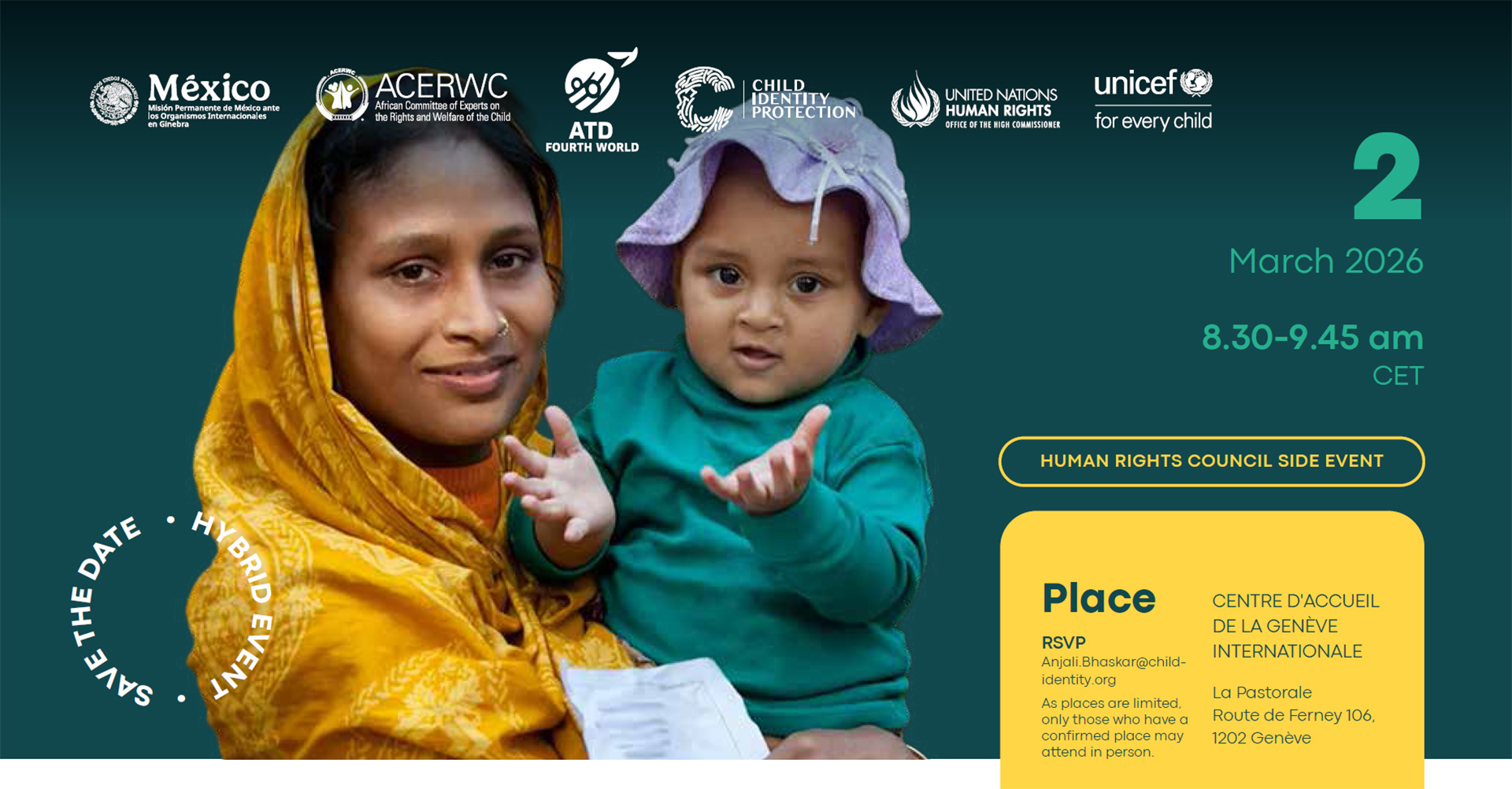
Side event: Digitalisation and the child’s right to identity – a tool for inclusion or exclusion?
RECORDING
PHOTOS
Ambassador Francisca Méndez
Permanent Representative of Mexico to the UN Office in Geneva
Ambassador Méndez was born in Mexico City. She entered the Diplomatic Service of the Mexican Ministry of Foreign Affairs in 1991. She graduated as a BSc in Political Sciences and Public Administration and a MSc in Latin American Studies from the Mexican National Autonomous University (UNAM). She obtained her second MSc in Law and Economics from the Milan State University in Italy. She has diplomas in international politics, public diplomacy and Arab studies, the latter with professors from the University of Oxford.
In the Mexican Foreign Service Headquarters, Ambassador Méndez worked in the Department of Political Affairs and the Caribbean, in the Directorate for United Nations and in the Directorate for Global Affairs.
She was a Deputy Counselor in the Consulates in Milan and Barcelona. In the latter, she spent a year and a half in charge of the Consulate. Following these postings, Ambassador Méndez was Deputy Head of Mission in Romania, Costa Rica and Spain where she ended her assignment as Chargé affairs for eight months. Her last international assignment, she acted as Deputy Head of Mission for European Union, Kingdom of Belgium and Grand-Duchy of Luxemburg.
She has served as Director General for American Regional Organizations and Mechanisms and served as National Coordinator of Mexico in the Pacific Alliance, in the Ibero-American Summit and in the Community of Latin American and Caribbean States and also as Special Advisor to the Undersecretary for Latin America and the Caribbean in business and educational matters.
From January 2017 to February 2022, she served as Ambassador of Mexico in the United Arab Emirates, being the first Mexican woman from the SEM accredited in a country of the Arabian Gulf, where she also participated in Iraq and represented before the International Energy Agency. Renewables based in Abu Dhabi. She was awarded by the Emirati Government with the highest distinction “First Class Independence Decoration”.
Since February 2022, Ambassador Méndez has been Permanent Representative in the Mission of Mexico to the United Nations and International Organizations based in Geneva.
Throughout her career, she has represented Mexico in more than three hundred meetings in multilateral and regional forums and has been characterized by her ability to negotiate and create consensus. In the Representations where she has been, Ambassador Méndez has carried out intense work of economic, cultural and cooperation promotion.
She has given several conferences and written articles on Mexican foreign policy, sustainable development, gender equality, people with disabilities, multilateralism, among others. She edited the book “The headquarters of the Mexican Embassy in Costa Rica: testimony of a solid and constructive relationship” and is the author of the e-book “The links between the European Union and Latin America and the Caribbean: History and perspective of regional integration”.
In November 2022 she presented her book at the FIL in Guadalajara “Why Fer doesn’t want to grow?”, which talks about autism. She has been very active in issues of gender equality and people with disabilities.
Her native language is Spanish and she speaks English, French and Italian.
She is married to Jan-Jilles van der Hoeven and has two children, Francisca, 31, and Fernando, 30.
Professor Philip Jaffé
Vice-Chairperson United Nations Committee on the Rights of the Child (moderator)
Philip D. Jaffé est professeur honoraire à l’Université de Genève. Il a cofondé son Centre interfacultaire en droits de l’enfant et l’a dirigé de 2008 à 2019. En 2018, il est élu au Comité des droits de l’enfant des Nations Unies et il accomplit son deuxième mandat jusqu’en 2027. Psychologue clinicien et forensique, formé en Suisse et aux USA, il exerce encore comme psychothérapeute et expert aux tribunaux. Sa vision professionnelle a toujours été de servir la société civile comme scientifique praticien.
Hon. Sabrina Gahar
Chairperson African Committee of Experts on the Rights and Welfare of the Child
Pr Sabrina GAHAR est Présidente du Comité Africain d’Experts sur les Droits et le Bien-être de l’Enfant (Union africaine) et Rapporteure spéciale sur les enfants en mouvement au sein de l’ACERWC. Elle est également Experte indépendante des Nations Unies au Comité pour la protection des droits de tous les travailleurs migrants et des membres de leur famille (CMW–HCDH).
Professeure en psychologie clinique à l’Université d’Alger 2, elle dirige une équipe de recherche au LAPCM spécialisée dans l’étude des traumatismes. Engagée depuis plus de 34 ans dans la défense et la promotion des droits de l’enfant, elle est Vice-présidente de la Fondation nationale pour la promotion de la santé et le développement de la recherche (FOREM) et Présidente du Conseil scientifique de l’Observatoire des droits de l’enfant.
Elle a collaboré étroitement avec l’UNICEF Algérie en qualité d’experte consultante et rapporteure, notamment sur les impacts de la pandémie sur les enfants, et a contribué à l’élaboration de rapports nationaux relatifs à la situation de l’enfance et aux systèmes de protection. Elle a également été membre du Conseil national des droits de l’homme (CNDH), nommée par décret présidentiel, où elle a exercé comme rapporteure au sein de la commission chargée des femmes, des enfants et des personnes vulnérables.
Son parcours conjugue expertise académique, engagement institutionnel et action normative aux niveaux national, régional et international.
Helen Griffiths
Human Rights Officer, Office of the United Nations High Commissioner for Human Rights
Helen Griffiths is a Human Rights Officer with the Child and Youth Rights Unit of the Office of the United Nations High Commissioner for Human Rights. She focuses on a range of child and youth rights issues, including implementing intergovernmental mandates and justice.
She previously worked for the Children and Young People’s Commissioner Scotland and Defence for Children International, where she advised on law, policy, and practice and conducted advocacy on children’s rights, particularly with international human rights mechanisms. She also worked for Human Rights Watch, supporting on a range of child rights issues and conducting research and advocacy on the rights of migrant and asylum-seeking children and on the right to education.
She holds a B.A. (Hons) from Te Whare Wānanga o Waitaha / the University of Canterbury, an M.A. in International Peace and Security from King’s College London, and an LL.M. in International Human Rights Law and Practice from the University of York.
Bhaskar Mishra
Child protection specialist, UNICEF (moderator)
Bhaskar Mishra works as the Civil Registration and Vital Statistics and Legal Identity Specialist with UNICEF HQ, New York. He also supports UNICEF’s work on the UN Legal Identity Agenda. From 2016 to 2021, Bhaskar worked with the UNICEF Tanzania CO as the Child Protection Specialist for Birth & Death Registration, supporting the Government of Tanzania in scaling up the simplified birth and death registration system. Previously, Bhaskar worked as the Deputy Registrar General responsible for implementing India’s birth and death registration system.
Christopher
Tapori Children’s Parliament in Central African Republic, ATD Fourth World
The Tapori Children’s Parliament in Central African Republic is a vibrant initiative by the ATD Fourth World, which aims to unite children from diverse backgrounds to advocate for their rights and well-being. The parliament, which has been active since November 2020, consists of children aged 8 to 16 years old and represents a diverse range of backgrounds, including those living in extreme poverty and those from affluent families. The parliament’s activities focus on issues such as education, health, and the protection of children’s rights, and birth registration. https://www.atd-fourthworld.org/children-advocates/