

Global Webinar Series: Preventing and responding to Illicit Intercountry Adoptions
REGISTRATION
OVERVIEW
Human rights based frameworks for access to justice and effective remedies
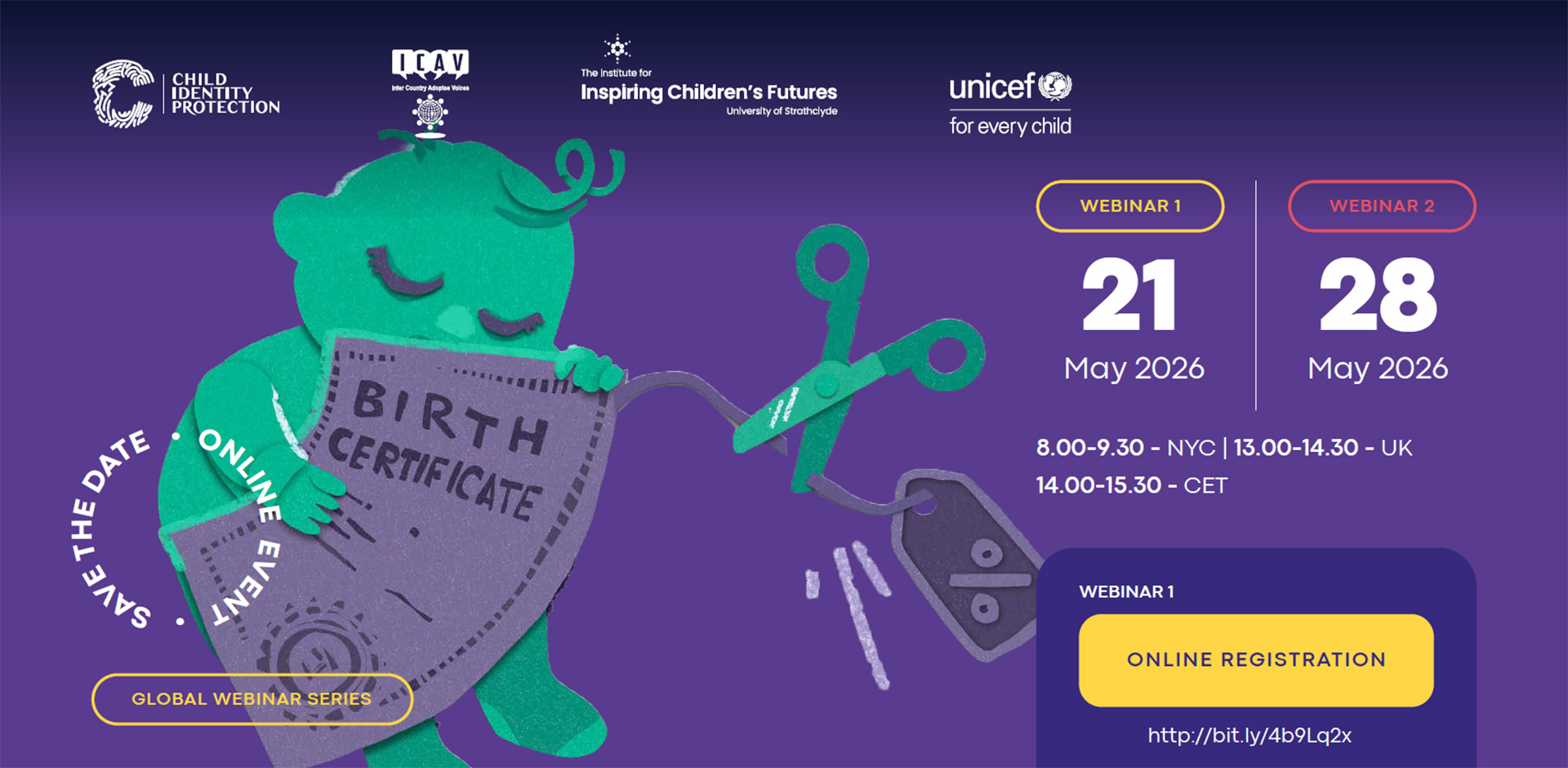
Date: 21 May 2026 (webinar 1) and 28 May 2026 (webinar 2)
Time: Start: 0800 NYC/ 1300 UK/ 1400 CET and End : 0930 NYC/ 1430 UK/ 1530 CET
Registration link webinar 1 : http://bit.ly/4b9Lq2x
Registration link webinar 2 : https://bit.ly/4ua8PJW
Overview:
There is now broad recognition of the systemic illicit nature of past practices in both national and intercountry adoptions. Today, many but not all of these illicit practices have been prevented thanks to the introduction of international safeguards such as the UN Convention on the Rights of the Child (CRC), Convention of 29 May 1993 on Protection of Children and Co-operation in Respect of Intercountry Adoption (1993 Adoption Convention) and Convention on Enforced Disappearances (CED). Enabling environments for such practices have been comprehensively outlined by the UN SR on sale and sexual exploitation in her landmark 2016 report.
The impact of these illicit adoptions has wide ramifications for the adoptee, birth family and adoptive family, in terms of rights violations including preservation of identity, protection against sale, trafficking and enforced disappearances. International standards create obligations on States to provide Access to Justice and Effective Remedies (AJER) in response to such violations. Human rights, including transitional justice, require the establishment of truth; procedural justice and substantive outcomes such as restitution; compensation; recovery; reintegration and non-recurrence.
Webinar objectives:
The first webinar is dedicated to State obligations and responses in past contexts, notably in terms of overcoming obstacles such as statutes of limitations and jurisdiction limitations. The second webinar targets State responsibilities and initiatives preventing and addressing current illicit practices, including how to ensure a child-centred approach.
Webinar 1 : State prevention and responses to past illicit ICAs
Over the past few years, a number of States have started to tackle patterns of illicit ICAs with a growing number establishing “truth finding initiatives.” While there have been ad hoc efforts to respond to the violations uncovered, opportunities exist to improve alignment with international standards and implementation of the substantive outcomes they provide for.
Moderator : Nigel Cantwell, International child protection consultant
Speakers :
- Ann Skelton, immediate former Chairperson of the UN Committee on the Rights of the Child
- Olivier de Frouville, Vice-chairperson of the UN Committee on Enforced Disappearances
- Lynelle Long, Executive Director ICAV
- Boonyoung Han and Peter Møller, Danish Korean Adoptees
- Joelle Schickel-Kung, Head of Private International Law Swiss Federal Ministry of Justice
- State of Origin, Central Adoption Authority (tbc)
Webinar 2 : State prevention and responses to current illicit ICAs
To prevent illicit ICAs, multiple States have ratified international standards, notably the 1993 Adoption Convention and collectively worked with the HCCH through Special Commissions and dedicated working groups to identify minimum standards. In response to current illicit ICA practices, States have introduced different moratoriums, laws and policies to sanction rights violations. National jurisprudence has also been developing.
Moderator : Maud de Boer-Buquicchio, former UN SR on sale and sexual exploitation of children and President, Child Identity Protection
Speakers :
- Benoit Van Keirsbilck, Member of the UN Committee on the Rights of the Child
- Laura Martinez-Mora, First Secretary, Hague Conference on Private International Law
- Ms Rachel Harvey, Senior Adviser Child Protection and Migration, Global Lead Violence Prevention and Response Systems, UNICEF
- Linda Reynolds, Inter-Parliamentary Union lead on 2025 statement
- Ariane van den Berge, Belgium Flemish Central Adoption Authority
- State of Origin, Central Adoption Authority (tbc)
Cadres fondés sur les droits humains pour l’accès à la justice et des recours efficaces
Date: 21 mai 2026 (webinaire 1) and 28 mai 2026 (webinaire 2)
Heure: Début: 0800 NYC/ 1300 UK/ 1400 CET et fin : 0930 NYC/ 1430 UK/ 1530 CET
Lien d’inscription au webinaire 1 : http://bit.ly/4b9Lq2x
Lien d’inscription au webinaire 2 : https://bit.ly/4ua8PJW
Aperçu :
Il est désormais largement reconnu que les pratiques passées en matière d’adoption nationale et internationale étaient illicites sur un plan systémique. Aujourd’hui, bon nombre de ces pratiques illicites, mais pas toutes, ont été évitées grâce à la mise en place de garanties internationales telles que la Convention des Nations Unies relative aux droits de l’enfant (CDE), la Convention du 29 mai 1993 sur la protection des enfants et la coopération en matière d’adoption internationale (Convention de 1993 sur l’adoption) et la Convention sur les disparitions forcées (CDF). Les environnements propices à de telles pratiques ont été décrits de manière exhaustive par la Rapporteuse spéciale des Nations Unies sur la vente et l’exploitation sexuelle dans son rapport historique de 2016.
Ces adoptions illégales ont des conséquences importantes pour les personnes adoptées, leur famille biologique et leur famille adoptive, en termes de violation de droits, notamment le droit à la préservation de l’identité, à la protection contre la vente, la traite et les disparitions forcées. Les normes internationales imposent aux États l’obligation de garantir l’accès à la justice et des recours effectifs (AJER) en réponse à ces violations. Les droits de l’homme, y compris la justice transitionnelle, exigent l’établissement de la vérité, la justice procédurale et des résultats concrets tels que la restitution, l’indemnisation, le rétablissement, la réintégration et la non-répétition.
Objectifs des webinaires:
Le premier webinaire est consacré aux obligations et aux réponses des États dans des contextes passés, notamment en termes de comment surmonter des obstacles tels que les délais de prescription et les limitations de compétence. Le deuxième webinaire porte sur les responsabilités et les initiatives des États visant à prévenir et à lutter contre les pratiques illicites actuelles, y compris la manière de garantir une approche centrée sur l’enfant.
Webinaire 1 : Prévention et réponses des États aux adoptions internationales (AI) illicites passées
Au cours des dernières années, plusieurs États ont commencé à s’attaquer aux pratiques illicites en matière d’AI (adoptions internationales), et un nombre croissant d’entre eux ont mis en place des « initiatives visant à établir la vérité ». Bien que des efforts ponctuels aient été déployés pour répondre aux violations mises au jour, il est possible d’améliorer l’alignement aux normes internationales et la mise en œuvre des résultats concrets qu’elles prévoient.
Modérateur : Nigel Cantwell, consultant international en protection de l’enfance
Intervenants :
- Ann Skelton, ancienne Présidente du Comité des droits de l’enfant des Nations Unies
- Olivier de Frouville, Vice-président du Comité des disparitions forcées des Nations Unies
- Lynelle Long, Directrice de l’ICAV
- Boonyoung Han et Peter Møller, adoptés danois d’origine coréenne, présenteront le travail de la Commission vérité coréenne et la manière dont les adoptés ont facilité son travail.
- Joelle Schickel-Kung, responsable du droit international privé, ministère fédéral suisse de la Justice
- État d’origine, autorité centrale en matière d’adoption (à confirmer)
Webinaire 2 : Prévention et réponses des États face aux pratiques actuelles illicites en matière d’adoption internationale
Afin de prévenir les pratiques illicites en matière d’adoption internationale, plusieurs États ont ratifié des normes internationales, notamment la Convention de 1993 sur l’adoption, et ont collaboré avec la HCCH dans le cadre de commissions spéciales et de groupes de travail dédiés afin d’identifier des normes minimales. En réponse aux pratiques illicites actuelles en matière d’adoption internationale, les États ont mis en place différents moratoires, lois et politiques visant à sanctionner les violations des droits. La jurisprudence nationale s’est également développée.
Modératrice : Maud de Boer-Buquicchio, ancienne Rapporteuse spéciale des Nations unies sur la vente et l’exploitation sexuelle des enfants et Présidente de Child Identity Protection.
Intervenants :
- Benoit Van Keirsbilck, membre du Comité des droits de l’enfant des Nations Unies
- Laura Martinez-Mora, Première Secrétaire de la Conférence de La Haye de droit international privé
- Ms Rachel Harvey, Senior Adviser Child Protection and Migration, Global Lead Violence Prevention and Response Systems, UNICEF
- Linda Reynolds, Responsable de la Déclaration de 2025 de l’Union interparlementaire
- Ariane van den Berghe, Autorité centrale en matière d’adoption de Belgique
- État d’origine, autorité centrale en matière d’adoption (à confirmer)
Los marcos basados en derechos humanos para el acceso a la justicia y a recursos efectivos
Fecha: 21 de mayo 2026 (Seminario virtual 1) y 28 de mayo de 2026 (Seminario virtual 2)
Hora: Inicio: 08:00 NYC/ 13:00 UK/ 14:00 CET y conclusión: 09:30 NYC/ 14:30 UK/ 15:30 CET
Registro al Seminario virtual 1 : http://bit.ly/4b9Lq2x
Registro al Seminario virtual 2 : https://bit.ly/4ua8PJW
Resumen:
Hoy en día se reconoce ampliamente la naturaleza ilícita sistémica de las prácticas anteriores en las adopciones tanto nacionales como internacionales. Hoy en día, muchas de estas prácticas ilícitas, aunque no todas, se han evitado gracias a la introducción de garantías internacionales como la Convención de las Naciones Unidas sobre los Derechos del Niño (CDN), la Convenio de 29 de mayo de 1993 relativo a la Protección del Niño y a la Cooperación en materia de Adopción Internacional (Convención sobre Adopción de 1993) y la Convención sobre las Desapariciones Forzadas (CED). La Relatora Especial de las Naciones Unidas sobre la venta y la explotación sexual ha descrito de manera exhaustiva los entornos que propician estas prácticas en su histórico informe de 2016.
El impacto de estas adopciones ilícitas tiene amplias ramificaciones para la persona adoptada, la familia biológica y la familia adoptiva, en términos de violaciones de derechos, incluida la preservación de la identidad y la protección contra la venta, la trata y las desapariciones forzadas. Las normas internacionales imponen a los Estados la obligación de proporcionar acceso a la justicia y recursos efectivos (AJRE) en respuesta a tales violaciones. Los derechos humanos, incluida la justicia transicional, exigen el establecimiento de la verdad, la justicia procesal y resultados sustantivos como la restitución, la indemnización, la recuperación, la reintegración y la no repetición.
Objetivos del seminario virtual:
El primer seminario web está dedicado a las obligaciones y respuestas de los Estados en contextos pasados, en particular en lo que respecta a la superación de obstáculos como la prescripción y las limitaciones jurisdiccionales. El segundo seminario web se centra en las responsabilidades e iniciativas de los Estados para prevenir y abordar las prácticas ilícitas actuales, incluyendo cómo garantizar un enfoque centrado en los niños y niñas.
Seminario virtual 1 : Prevención y respuestas por parte de los Estados a las adopciones internacionales ilícitas del pasado
En los últimos años, varios Estados han comenzado a abordar los patrones de adopciones internacionales ilícitas y cada vez son más los que establecen “iniciativas para descubrir la verdad”. Si bien se han realizado esfuerzos puntuales para responder a las violaciones descubiertas, existen oportunidades para mejorar la armonización con las normas internacionales y la aplicación de los resultados sustantivos que estas proporcionan.
Moderador: Nigel Cantwell, Consultor internacional en protección a la niñez
Ponentes:
- Ann Skelton, antigua Presidenta del Comité de los Derechos del Niño de la ONU
- Olivier de Frouville, Presidente Adjunto del Comité de la ONU contra la Desaparición Forzada sobre cómo el Comité de Desapariciones Forzadas
- Lynelle Long, Directora Ejecutiva de Inter-Country Adoption Voices (ICAV) para ofrecer un panorama de las iniciativas que responder a las adopciones internacionales ilícitas del pasado
- Boonyoung Han y Peter Møller, personas adoptadas danesas-coreanas para presentar el trabajo de la Comisión Coreana de Verdad y cómo las personas adoptadas han facilitado su trabajo
- Joelle Schickel-Kung, Responsible de Derecho Internacional Privado en el Ministerio de Justicia de Suiza
- Estado de origen, autoridad central de adopción (por confirmar)
Seminario virtual: Prevención y respuestas de los Estados a las adopciones internacionales ilícitas actuales
Para prevenir las adopciones internacionales ilícitas, varios Estados han ratificado normas internacionales, en particular la Convención de 1993 sobre Adopción, y han trabajado de forma conjunta con la Conferencia de La Haya de Derecho Internacional Privado a través de comisiones especiales y grupos de trabajo específicos para definir unas normas mínimas. En respuesta a las prácticas actuales de adopción internacional ilícita, los Estados han introducido diferentes moratorias, leyes y políticas para sancionar las violaciones de derechos. También se ha ido desarrollando la jurisprudencia nacional.
Moderadora: Maud de Boer-Buquicchio, antigua Relatora Especial de la ONU sobre la venta y explotación sexual de niños y Presidenta de Child Identity Protection
Ponentes:
- Benoit Van Keirsbilck, Miembro del Comité de los Derechos del Niño para hablar de la Observación General sobre el acceso a la justicia y a los recursos efectivos
- Laura Martinez-Mora, Primera Secretaria en la Conferencia de La Haya de Derecho Internacional Privado para presentar la labor de la HCCH a través de Comisiones Especiales y Grupos de Experta/os, incluido el Conjunto de herramientas
- Ms Rachel Harvey, Senior Adviser Child Protection and Migration, Global Lead Violence Prevention and Response Systems, UNICEF
- Linda Reynolds, Responsable de la Declaración de 2025 de la Unión Interparlamentaria
- Ariane van den Berghe, Responsable de la Autoridad Central en materia de adopción de la Comunidad flamenca de Bélgica
- Estado de origen, autoridad central de adopción (por confirmar)

Nigel Cantwell
International child protection consultant (moderator)
Dr Nigel Cantwell is a Geneva-based international consultant on child protection policies. He founded the NGO Defence for Children International in 1979 and coordinated the inputs of the NGO Group for the Convention on the Rights of the Child throughout the drafting of that treaty. Following six years leading work on child protection issues at UNICEF’s Innocenti Research Centre, he has focused mainly on enhancing policy and practice for safeguarding the human rights of children affected by intercountry adoption and alternative care. In 2017, the University of Strathclyde awarded him an honorary doctorate in recognition of his work.

Olivier de Frouville
Vice-chairperson of the UN Committee on Enforced Disappearances
Olivier de Frouville est professeur de droit public à l’Université Panthéon-Assas (Paris II) et directeur du Centre de Recherche sur les Droits de l’Homme et le Droit Humanitaire / Paris Center for Human Rights (C.R.D.H.) Il a été membre de l’Institut Universitaire de France de France de 2012 à 2018 et a entrepris dans ce cadre une recherche sur une « théorie démocratique du droit international ». Il enseigne actuellement le droit international général, le droit international des droits de l’Homme et le droit international pénal à l’Université Panthéon-Assas. Il dispense également des cours de droit international des droits de l’Homme à l’Académie de Genève sur le droit humanitaire et les droits humains.
Parallèlement à sa carrière universitaire, Olivier de Frouville travaille depuis plus de vingt-cinq ans en tant qu’expert en matière de droits de l’Homme dans le cadre de l’ONU. En juin 2019, il a été élu membre du Comité sur les disparitions forcées des Nations Unies. Il a été réélu pour un second mandat de quatre en juin 2023 , puis élu Président du Comité en septembre 2023. Auparavant, il a été membre du Comité des droits de l’Homme des Nations Unies (2015-2018) et du Groupe de travail des Nations Unies sur les disparitions forcées ou involontaires (2008-2014), dont il a été le Président-Rapporteur d’avril 2012 à octobre 2013. Il a également été membre du Comité de coordination des procédures spéciales des Nations Unies durant l’année 2013-2014.
De 2009 à 2020 , il a été expert désigné par la France au titre du Mécanisme de la dimension humaine de l’O.S.C.E.
Au niveau national, il a été membre de la Commission nationale consultative des droits de l’homme française (CNCDH) entre 2009 et 2015.
De août 2011 à août 2012, Olivier de Frouville a été «visiting fellow» au Lauterpacht Center for International Law de l’Université de Cambridge (Royaume-Uni) et à Clare Hall, un collège de l’Université de Cambridge, dont il est devenu membre à vie en 2013.
Ses domaines de recherche couvrent le droit international général, la théorie du droit international, le droit international des droits de l’Homme, le droit international humanitaire et le droit international pénal. Son parcours de recherche est marqué par un aller et retour constant entre la théorie et la pratique, de la théorie du cosmopolitisme juridique aux « chantiers cosmopolitiques » que sont par exemple le statut de la société civile internationale dans les organisations internationales ou la création d’une Cour des droits de l’Homme des Nations Unies. Ces travaux sur le présent et l’avenir du droit international s’accompagnent d’une réflexion sur l’éthique de la pratique juridique.

Lynelle Long
Executive Director ICAV
Lynelle Long is a Vietnamese adoptee born in the early 70s, Founder of InterCountry Adoptee Voices (ICAV). ICA is one of the largest platforms worldwide to bring together the leaders of intercountry adoptee led groups around the globe. Her network is a critical thinking space that advocates for the needs and rights of intercountry adoptees. She has been a consultant to central authorities in intercountry adoption, is an author and contributor to books on intercountry adoption, initiates and coordinates meetings with adult intercountry adoptees and government authorities, is an Observer in The Hague Working Group on Addressing & Preventing Illicit Practices in Adoption, guest speaker at training sessions and conferences for various Central Authorities and post adoption organisations worldwide.


Joelle Schickel-Kung
Head of Private International Law Swiss Federal Ministry of Justice
Joëlle SCHICKEL-KÜNG is Deputy Head of the Private Law Division and Co-Head of the Private International Law Unit (PIL Unit), Federal Office of Justice of Switzerland. She is a trained lawyer and has been working for 15 years in the Swiss government on issues of cross-border child protection and family law. As Co-Head of the PIL Unit she is in charge of the child protection and family law area which includes legislative reforms as well as the Central Authority function under the Hague Conventions of 1993 (intercountry adoptions, which also includes questions around search of origins), 1996 (international child protection) and 1980 (international child abduction). She served as Chair of the HCCH Experts’ group on the Parentage/Surrogacy Project of the HCCH (2016-2022) and is currently a member of the HCCH Working Group on the same topic.

Maud de Boer-Buquicchio
Former UN SR on sale and sexual exploitation of children and President, Child Identity Protection
Maud de Boer-Buquicchio is internationally recognised as a leading expert in human rights. Notably she was appointed as the United Nations Special Rapporteur on the sale of children, child prostitution and child pornography (2014 – 2020) and was the Deputy Secretary General of the Council of Europe (2002 – 2012). Throughout her mandates, she has been focusing her attention on the fight against discrimination and violence, on the rights of the most vulnerable groups in society, in particular, children. She spearheaded three key Council of Europe Conventions: the Convention on action against trafficking in human beings, the Convention on the protection of children from sexual exploitation and sexual abuse and the Convention on preventing and combating violence against women and domestic violence. In her role as President of Child Identity Protection, she will bring with her decades of experience and determination in tackling sensitive issues connected to children’s identity rights, such as those arising from illegal adoption practices, commercial surrogacy arrangements and other questionable commercial practices. Maud de Boer-Buquicchio is a fluent speaker of Dutch, English, French, Italian and German.

Benoit Van Keirsbilck
Member of the UN Committee on the Rights of the Child
Benoit Van Keirsbilck is the Director of the Belgian section of Defence for Children – International (DCI). He is Chief Editor of the Journal of Children’s Law (Belgium) and member of the Advisory board of the UN Global Study on children deprived of liberty. He is a member of the Interdisciplinary Center for the Rights of the Child, which organises academic courses and develops research. He has been elected as a member of the UN Committee on the Rights of the Child (2021-2024 and 2025-2029).

Laura Martinez-Mora
First Secretary, Hague Conference on Private International Law
Works as a Secretary (Lawyer) at the Permanent Bureau of the Hague Conference on Private International Law (HCCH). She is responsible for the post-Convention work in relation to the HCCH 1993 Convention on Child Protection and Cooperation in Respect of Intercountry Adoption, as well as the Parentage / Surrogacy project. Laura has also worked on children’s issues at the International Social Service (Switzerland); UNICEF (Chile); the European Commission (Belgium) and the Council of Europe (France). She received her law degree from the University of Valencia (Spain), a Master of Laws (LL.M) in International Law with a specialisation in child’s rights (University of London, UK), and a Diploma in Child Protection and Juvenile Justice (University Diego Portales, Chile).

Ms Rachel Harvey
Senior Adviser Child Protection and Migration, Global Lead Violence Prevention and Response Systems, UNICEF
Ms Rachel Harvey Senior Adviser Child Protection and Migration, Global Lead Violence Prevention and Response Systems, UNICEF
Rachel Harvey is UNICEF’s Global Lead for Violence Prevention and Response Systems. She has over 25 years of experience in research, advocacy and programming on child protection, justice for children and child rights in development and emergency contexts, including in Central Asia, Africa, East Asia, Central America, Eastern Europe and the Caucuses. She joined UNICEF in 2010 in Tanzania, moved to Nigeria as the Chief of Child Protection in 2014, then to the UNICEF HQ Child Protection team in 2017, working on the VAC agenda, and from 2018-2026 she was Regional Adviser Child Protection for UNICEF East Asia and Pacific Regional Office. Prior to joining UNICEF, Rachel worked with the Children and Armed Conflict Unit (University of Essex, UK) and then the Children’s Legal Centre (now Coram International) for over 10 years, where she was Head of International Programmes. She holds a Masters Degree in International Human Rights Law.

Ariane van den Berghe
Belgium Flemish Central Adoption Authority
Ariane Van Den Berghe is a lawyer by training. Since 2012 she is the director of the Flemish Central Authority for intercountry adoption, (VCA – Vlaams Centrum voor Adoptie), which is embedded in the governmental agency responsible for all services and policies regarding children and families (Opgroeien). As a governmental lead, she is responsible for the coordination, regulation, and quality assurance of adoption procedures, ensuring alignment between policy, practice, and children’s rights.
In recent years, VCA’s policy has placed a strong emphasis on reducing the risk of malpractice in intercountry adoption.